

 by Thornton Waite
Built through sparsely populated northern Maine to convey agricultural products and timber to markets in southern New England and beyond, Bangor & Aroostook Railroad (known as “B&A” to locals, but with reporting marks BAR) ran a limited number of passenger trains. One of them was an overnight train providing sleeping cars between Boston and northern Maine points. Its name, the Potatoland Special, celebrated the valuable commodity grown and harvested along its route.
Starting in 1936, BAR also offered bus service to complement its passenger trains. The railroad made a valiant effort to maintain the quality of passenger service, but discontinued its last overnight sleepers in 1959, victims of the automobile and construction of parallel I-95. However, an overnight passenger train remained in the timetable for another two years, with coaches and limited food service. This train ended on October 4, 1961, but the railroad’s bus service continued until 1984.
Origins
Construction of BAR took many years, and the line from Bangor, Maine, 221 miles north to Van Buren, in the far northern reaches of the state, was not completed until November 1, 1899. The railroad then had a through route between Bangor, where it connected with Maine Central (MEC), and northern Maine points such as Van Buren and Houlton. It was not until 1915 that the construction of a bridge across the Saint John River at Van Buren was completed, enabling BAR to connect with Canadian National predecessor National Transcontinental Railway in New Brunswick. The railroad then had a network of 630 miles of track in northern Maine. BAR operated local passenger trains on all of its branch lines, scheduled to connect with the main line passenger trains. Even at this early date, however, the railroad was looking at ways to minimize the cost of the local trains, and in 1912 had two gas-electric cars in service.
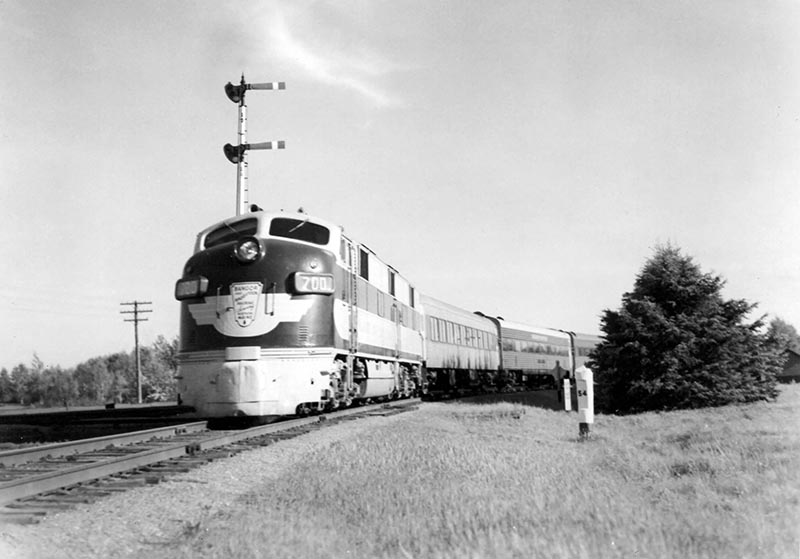
ABOVE: In a photograph used by Bangor & Aroostook on its 1950s public timetable covers and elsewhere, E7A 700 leads a train of “American Flyer” and stainless-sheathed streamlined cars. —Kevin J. Holland collection
BAR’s February 1901 timetable listed trains 1 and 4 between Bangor and Van Buren daily except Sunday. Train 1 took 9 hours 5 minutes for the 221-mile trip, leaving Bangor at 7:00AM and arriving in Van Buren, 33 miles north of Caribou, at 4:05PM. Southbound Train 4 left Van Buren at 10:05AM and arrived in Bangor at 7:20PM.
BAR also had a second train pair, 29 and 102, between Bangor and Van Buren. This schedule offered “Pullman Buffet Parlor Cars” between Bangor and Caribou, leaving Bangor at 3:10PM and arriving Caribou at 10:15PM. The south-bound train left Caribou at 6:25AM and arrived Bangor at 1:05PM, and also ran daily except Sunday. Trains did not run on Sundays. All had connections at Bangor to and from Boston via Portland, Maine. There were other local trains along BAR’s main line between Bangor and Van Buren in addition to branch line locals.
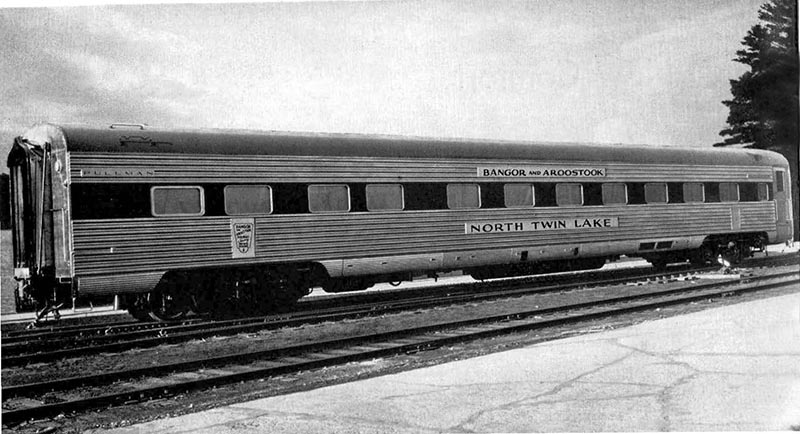
ABOVE: This retouched, hand-lettered photo depicting BAR North Twin Lake was featured in a booklet which promoted the prewar and postwar streamlined coaches built for BAR by Pullman-Standard. —Kevin J. Holland collection
By January 1910, the railroad was running both a day train and a night train between Bangor and Van Buren, daily except Sunday, in addition to the other lo-cal trains along the main line and on the branch lines. The day trains were numbered 2 and 3, taking approximately 10 hours between the two cities. The night trains were numbered 1 and 8, and advertised through Pullman service between Boston and Caribou, although the train ran through to Van Buren. Train 1 had a connection leaving Boston at 7:00PM, departure from Bangor at 3:05AM, with arrival at Van Buren at 11:35AM. South-bound Train 8 left Van Buren at 2:15PM, with an 11:55PM arrival at Bangor and an 8:25AM arrival in Boston.
The schedule for June 1916 showed there were day trains 2 and 7 and night trains 1 and 8 between Bangor and Van Buren via Caribou, with through connections to and from Boston. Again, the BAR trains ran daily except Sunday. The night trains had Pullman buffet-sleeping cars between Caribou and Boston, probably because the Caribou–Van Buren leg was in the daytime hours. The train took approximately nine hours to travel between Bangor and Van Buren. The use of a buffet-sleeping car was indicative of the light passenger loading on the trains. It provided light meal service and a reduced number of sleeping berths in the sleeping car. Only two cars were required to cover this service.
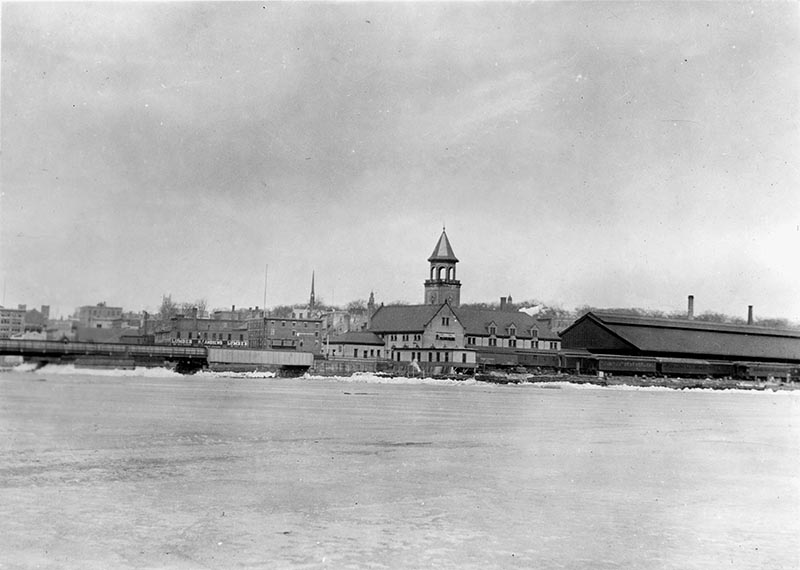
ABOVE: Serving trains of Bangor & Aroostook and Maine Central, Bangor Union Station, topped by its 130-foot-tall clock tower, opened in July 1907 on the west bank of the Penobscot River. The 500-foot-long gable-roofed train shed spanned eight tracks. The station closed on November 30, 1961, and was demolished soon after. —Bangor Public Library collection
The routing of the train in summer 1915 was unusual. Departing Boston as B&M/MEC Train 71 at 7:31PM, it became BAR Train 1 at Northern Maine Junction at 3:20AM, and arrived Caribou at 9:48AM, after traveling 434 miles. BAR Train 8 departed Caribou at 5:20PM, and became MEC Train 118 at Northern Maine Junction at 12:23AM. It then became B&M Train 36 at Portland, arriving Boston at 7:15AM, traveling 428 miles. The difference in mileages was due to the fact that Train 1 did not enter Union Station at Bangor, and went over B&M via Portsmouth and Old Orchard Beach. The car departing Boston on Saturday night ran only to Bangor and returned to Boston on Sunday night.
In 1926, BAR was continuing to run one day train and one night train over its main line between Bangor and Van Buren, a practice that continued into the 1950s. The night train ran as 1 and 8, numbers it kept for many years. By this time the sleeper had been extended to Van Buren and ran daily-except-Saturday from Boston and daily-except-Sunday from Van Buren. The trains also had a dining car, Millinocket–Van Buren, and through coaches, Bangor–Van Buren. In 1930 the train continued to offer the same service, although the dining club car ran between Millinocket and Phair, south of Caribou.
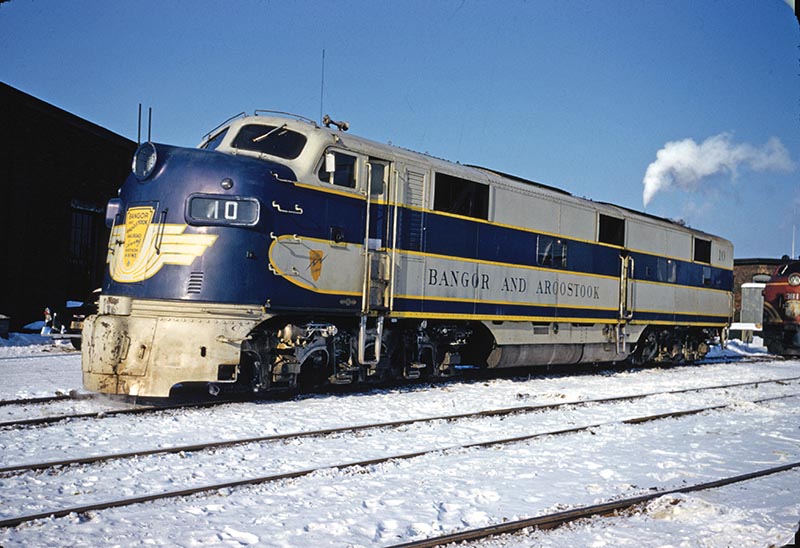
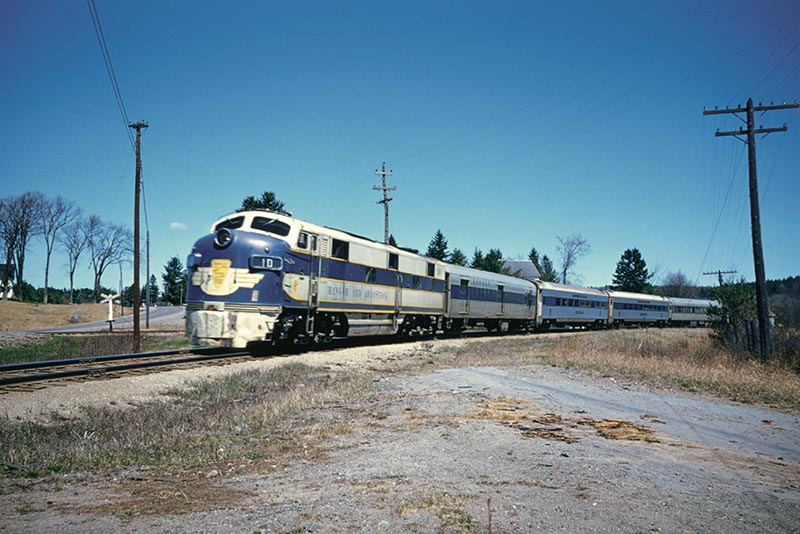
ABOVE: below Having recently arrived with the Aroostook Flyer, BAR E7A 10 awaits its next assignment at Bangor in January 1957 in the company of a Boston & Maine E7A. —David R. Sweetland photo
Depression-era Changes
Passenger miles plummeted in the Depression years, continuing a trend dating back to the peak in 1920, when 684,000 passengers traveled 27 million passenger miles. By 1930 the number of passenger miles was less than one half that number, 12.5 million passenger miles, bottoming out at less than 6 million passenger miles in 1932, and increasing to 12.5 million passenger miles in 1937. Over the years the trains also carried an unusual commodity during hunting sea-son — deer, moose, and bear that hunters had killed. In 1928, for example, the railroad recorded the shipment of 1,864 deer, 15 moose, and 25 bear, carried in the passenger trains’ baggage cars.
In 1937, BAR bought its first air-conditioned passenger cars to upgrade its passenger service. Previously, these trains had been using coaches built between 1902 and 1910. Built at Worcester, Mass., by Pullman-Standard’s Osgood-Bradley works, cars 150-152 seated 58 passengers in their buffet-lounges, and cars 230-231 had coach seats for 84 passengers. The railroad also bought two baggage-mail cars at the same time, while saying it was losing $500,000 a year on its passenger service. The buffet-lounge cars had stainless-steel kitchens and buffet-lounge service areas…